
This article is part of the HBOT Education series, where we explore what research tells us about hyperbaric oxygen therapy and specific health topics.
The Evidence, Clearly Explained — Brought to you by Brain Spa Hyperbaric
Disclaimer: This article is intended for educational and informational purposes only. It synthesizes published medical research and does not evaluate Brain Spa Hyperbaric products. The hyperbaric chambers offered on this website are non-medical wellness devices and are not intended to diagnose, treat, cure, or prevent any disease. Do not make medical decisions based on this article — consult a qualified healthcare professional.
In brief. Nine randomised trials in the 1980s gave people with MS twenty sessions of pure oxygen at about 2.0 ATA and, with two exceptions, found no benefit. The patient-run centres that started in the same year used a lower starting dose, adjusted it to each person, and continued weekly for years; their members report benefit, though without a control group. That protocol has never been tested in a trial, and neither has any dose below 1.75 ATA. This article follows both stories and explains why the two sides have been measuring different things.
In August 1982, a group of people with multiple sclerosis in Dundee, Scotland, did something no patient group had done before. They bought a hyperbaric chamber, installed it themselves, and started running sessions — for each other, without a hospital, without a neurologist in charge, and without waiting for anyone’s permission.
Within three years there were fifty such chambers across Britain, and the network later grew to more than sixty centres. By the estimate of Christopher Fox-Walker, a member for forty years whose story is below, they have delivered more than five million hours of oxygen therapy to over 50,000 people with MS. Some of the people who walked into the Dundee hyperbaric chamber in 1982 were still attending regularly thirty years later.
And here is what makes this story so contradictory: while all of that was happening, nine randomised trials were published on hyperbaric oxygen therapy for MS, and a Cochrane review that summarised them concluded there was no consistent evidence of benefit and that further trials were not justified.
Dozens of charities full of people who say it helps them. A stack of trials that mostly say it doesn’t. Whenever a contradiction like that survives for forty years, the useful question is not which side is right but what each side was measuring, because they turn out to have been measuring quite different things.
The trial that started everything
The story begins with a hypothesis that most neurologists rejected and a trial that most of them could not ignore.
In 1982, Philip James, a physician at the University of Dundee, proposed in The Lancet that MS lesions looked less like an immune attack and more like the aftermath of tiny blockages in the brain’s smallest blood vessels — the same kind of damage divers suffer in decompression sickness. Whether or not the mechanism was right, the treatment implication was clear: if the tissue around a lesion is short of oxygen, give it more oxygen under pressure.
A year later, Boguslav Fischer and colleagues at New York University published the first randomised, double-blind, placebo-controlled trial in the New England Journal of Medicine. Forty patients with advanced, long-standing MS. Twenty sessions of pure oxygen at 2.0 ATA — twice normal atmospheric pressure — for ninety minutes a day. The placebo was unusual, and it will matter later. Instead of ordinary air, the placebo group breathed a specially diluted gas — 10% oxygen, 90% nitrogen — at the same 2.0 ATA. The dilution cancelled out the extra oxygen that pressure would otherwise have delivered, so this group got the full pressure but no oxygen boost.
The results were striking. Twelve of the seventeen oxygen patients who completed the course showed objective neurological improvement. One of twenty placebo patients did. Improvement typically appeared around the twelfth session, and it showed up in the things that matter most to someone living with MS: walking, balance, fatigue. Nystagmus — the involuntary eye movement — disappeared in eight of thirteen patients who had it. Bladder control improved in five of thirteen.
Then Fischer followed everyone for a year with no further treatment. In the oxygen group, two patients (12%) had deteriorated. In the placebo group, eleven (55%) had — a rate Barnes would later point out was unusually high for the natural course of the disease. In seven of the twelve responders the improvement faded — after about six weeks on average. In five it lasted the whole year. Patients with milder disease did best and held their gains longest.
Fischer called it a small study with a short follow-up that “cannot be generally recommended” without confirmation. The patients read the paper differently. In Dundee, the charity ARMS ran its own open study of 38 people; the numbers were modest, but enough for the members, who started buying chambers. By early 1985, the Newcastle neurologists noted with some exasperation that “over fifty compression chambers have been established privately in the United Kingdom alone.” The patient movement and the clinical trials were born in the same year, from the same paper, and then went their separate ways.
What the biggest trial found — and what it noticed about the eyes
The trial that mattered most was run in Newcastle by Michael Barnes, David Bates and colleagues: 120 patients, the largest hyperbaric oxygen therapy trial in MS ever done, and the one that accounts for nearly a third of everyone in the Cochrane review. Same dose as Fischer — 100% oxygen, 2.0 ATA, ninety minutes, twenty sessions.
The placebo deserves a precise description. The chamber was pressurised to 1.1 ATA, one metre of seawater, held there for ten minutes so that everyone’s ears popped convincingly, then brought back to normal pressure, after which the placebo patients breathed ordinary air through the same face mask for ninety minutes.
At the end of treatment, no patient in either group had improved on the main disability scale. The only significant difference was in the one item on the scale that was based on what patients reported rather than what the neurologist measured: bladder and bowel function, better in 12 of 51 oxygen patients versus 3 of 47 on placebo. Overall, 53% of the oxygen group and 47% of the placebo group said they felt better — no real difference. At one year, the oxygen group had not progressed more slowly, had not had fewer relapses, and had not done better on a battery of cognitive tests.
That is the negative result, and it is real. But Barnes and Bates did something the smaller trials did not: they measured a great deal more than disability scores, and two of those measurements deserve a closer look.
First, they found one durable benefit. At one year, five oxygen patients had deteriorated in cerebellar function — balance and coordination — compared with fifteen placebo patients, a statistically significant difference. The authors flagged it as a possible chance finding among many comparisons, which is fair. But it is the same domain — balance and coordination — where Fischer had seen his strongest responses.
Second, and most intriguing, they looked at the eyes. Visual evoked potentials — the electrical response of the visual system to a flashing pattern — showed a significant drop in amplitude in the oxygen group, in both eyes, at the end of treatment. It recovered by six months. The authors’ interpretation: reversible retinal damage from oxygen toxicity. And then this: the effect was concentrated in patients with chronic progressive disease, not in those whose disease was stable. Their words: “on-going disease activity predisposes to oxygen damage.”
Alongside those two findings, the same trial recorded thirteen of the sixty oxygen patients with a week of overwhelming fatigue in the middle of the course, and nineteen with middle-ear injuries from pressure. In 1987, Barnes and Bates could describe, from their own tables, a dose that measurably stressed the very tissue it was meant to help, in the very patients who could least afford it, and had no framework for that observation except to note it and recommend against the therapy.
Same dose, same patients, opposite results
The obvious explanation for two trials disagreeing is that they enrolled different people. Here, they did not. Fischer’s patients had an average disability score of 5 and had been ill for twelve years; so had Barnes’s. If anything, Fischer’s group was the sicker one — three-quarters had progressive disease, against under half in Newcastle. The dose was identical. The number of sessions was identical.
What both trials did show, inside their own data, is that severity governs response. Fischer’s lasting responders were his least disabled patients; his most disabled either improved briefly or not at all, and he concluded that advanced disease leaves “only a small, if any, reversible component” for oxygen to work on. In Newcastle, the patients whose disease was progressing were the ones whose retinas registered the oxygen. Read together: the same dose that helped a milder patient may have been, for a sicker one, a dose the tissue could not handle. It is the pattern you would expect if tolerance of oxygen — not just response to it — falls as the disease advances. Neither trial was designed to test that, and it remains an inference. But it is the same inference from two trials that agreed on nothing else.
Nine trials, one dose
Fischer’s trial was the first of nine randomised trials published between 1983 and 1990, and in 2004 Michael Bennett and Robert Heard pooled them for the Cochrane Collaboration. Five hundred and four patients in total. Two trials were broadly positive: Fischer’s, and a Milan trial by Giorgio Oriani in 1990 that continued with weekly top-up sessions for a full year. Seven found no clear benefit.
The pooled data gave the reviewers little to work with. Their conclusion was blunt: no consistent evidence of benefit, routine use not justified, and — in the 2010 update — “some case for further human trials in selected subgroups and for prolonged courses at modest pressures, but the case is not strong.”
The reviewers tried hard to explain why two trials succeeded and seven did not. They split the trials by oxygen dose, by the type of placebo, and by treatment length. None of it worked: Fischer and Oriani landed in different subgroups every time.
But look at what the nine trials had in common, because it is the key to the whole story. Every one of them gave twenty sessions over four weeks. Every one of them used pure oxygen at between 1.75 and 2.5 ATA for ninety minutes — most at 2.0. Nobody tested lower. Nobody tested longer, except Oriani — who was one of the two that worked.
One more thing the nine trials shared: not one control group received nothing. Four trials used Newcastle’s brief compression, ten minutes at 1.1 ATA on air, which is a short exposure at a pressure one Moscow clinic treats at (more on that below). Four used Fischer’s diluted gas: 10% oxygen in nitrogen at 2.0 ATA, which cancels the extra oxygen but leaves the full pressure and adds nitrogen at nearly twice its normal partial pressure, an exposure nobody has studied. It was the New York control group, breathing that mixture, that deteriorated most over the following year: 55%, against 27% in Newcastle, while the two oxygen groups sat at 12% and 27%. And Oriani’s comparison group in Milan breathed ordinary air at 2.5 ATA, the highest pressure of the nine, which delivers about as much oxygen as a 50% mixture at sea level and is a treatment in its own right. Pressure alone acts on cells; pressurised air raises the oxygen dose; the nitrogen mixture is uncharacterised. As we have written before, “placebo” in a hyperbaric oxygen therapy trial is rarely inert. Since no control group received a true placebo, and every one of them got either an active dose or a gas mixture nobody has characterised, the nine trials compared one exposure against another. Clear conclusions, in either direction, are harder to draw from them than a summary line suggests.
There was a reason for 2.0 ATA. Fischer chose it because a German study had found that brain glucose metabolism was fine up to 2 ATA and impaired at 2.5. Barnes chose it because it was the highest pressure that seemed safe in a chamber holding six people at once. In his 1985 paper, Barnes mentions that Richard Neubauer, the Florida physician who had by then treated hundreds of MS patients, had recommended starting at 1.5 ATA and raising the pressure only for patients who did not respond — and explains that this was impossible to do in a multiplace chamber, so they fixed the dose at 2.0 for everyone. The variable-dose idea was on the table in 1985. It was set aside for practical reasons, not scientific ones.
Meanwhile, in Dundee, the patients had been doing exactly what Neubauer suggested.
What the centres did differently
The best description of what the patient-run centres actually did comes from David Perrins and Philip James, published in 2005. Perrins is an interesting figure in this story. A Cambridge-trained surgeon with decades of hyperbaric experience, he was a co-author on the Swedish MS trial of 1985 — one of the negative ones — and then spent the next twenty years collecting the records of the centres, unpaid, until his death in 2005.
The centres’ protocol was not the trials’ protocol. Everyone started at 1.5 ATA, breathing oxygen through a mask, one hour a day. After five sessions, the person was asked whether at least two of their symptoms had improved. If yes, they completed twenty sessions at 1.5. If not, the pressure went up in steps of 0.25 ATA, a step per week, until something responded — or until five sessions at 2.0 ATA had produced nothing, at which point the person was told the therapy probably wasn’t for them. After the initial course, members were invited back weekly, indefinitely.
Three things about this stand out. The starting dose was far lower than the trials’: a quarter less pressure, and sixty minutes instead of ninety. Put together, a centre session delivered about half the oxygen dose of a trial session. The dose was matched to the individual, by their own response. And the therapy did not end after four weeks — it was designed from the beginning to continue for years.
Perrins followed 703 people for ten to fourteen years after their first course. Of the 447 still analysable at the end (126 had died, 99 were lost, and a few had injuries or revised diagnoses), those who had come back for fewer than ten follow-up sessions had deteriorated by an average of two points on the disability scale, which is roughly the distance from walking unaided to needing a cane. Those who had attended more than four hundred sessions had deteriorated by one. After ten years, 23% had not deteriorated at all and 7% had improved. Among 117 people who had attended without interruption for five to seventeen years, disability had not increased by more than a single point. The bladder finding from the trials was confirmed at scale: among 523 members, night-time urination fell from 2.4 to 1.2 times a night after the initial course, and daytime frequency from 7.4 to 5.7.
These are records, not a controlled study, and they need to be read with that in mind. The people who came back four hundred times are likely to be the people who felt it helped, and those who felt nothing are under-represented in the long-attendance column. Records like these describe what happened to the people who stayed; whether staying caused the outcome is a question they cannot settle on their own.
But registries can tell you something trials cannot: what hyperbaric oxygen therapy looks like over a decade, in the hands of the people who actually use it. And the shape of what Perrins found — more sessions, less progression; earlier start, better response; symptoms like urinary frequency that return when the sessions stop — is the shape of an ongoing therapy for an ongoing disease. When the centres say on their websites that this “is not a cure,” that is what they mean. MS does not stop, and neither, in their experience, can the sessions.
Forty years in the chamber: one member’s account
Christopher Fox-Walker is 86 and lives in Eastbourne with his wife Linda. He joined the Sussex MS Centre in 1983 and later served as its chairman.
His symptoms began in the 1970s, while he was living and filming in Morocco: minor vision and speech problems, numbness in the legs, and a fatigue that forced him to abandon a master’s degree at Sussex University. It was not until 1982, at 42, after a series of tests and a lumbar puncture, that multiple sclerosis was confirmed. “It meant very little to me at the time,” he writes.
In 1983 his wife referred him to the Sussex MS Centre in Southwick, one of the patient-run charities described above. The dose that suited him was 2.0 ATA, the top of the centres’ range, one hour a week, breathing oxygen through a mask or hood. He continued every week for some forty years, more than 2,000 hours in the chamber, until about three years ago, when getting in and out of the chamber, the thirty-mile journey to the centre and an unrelated ear condition made the sessions impractical. He now breathes oxygen from a concentrator at home for an hour a day. He has never used a disease-modifying drug.
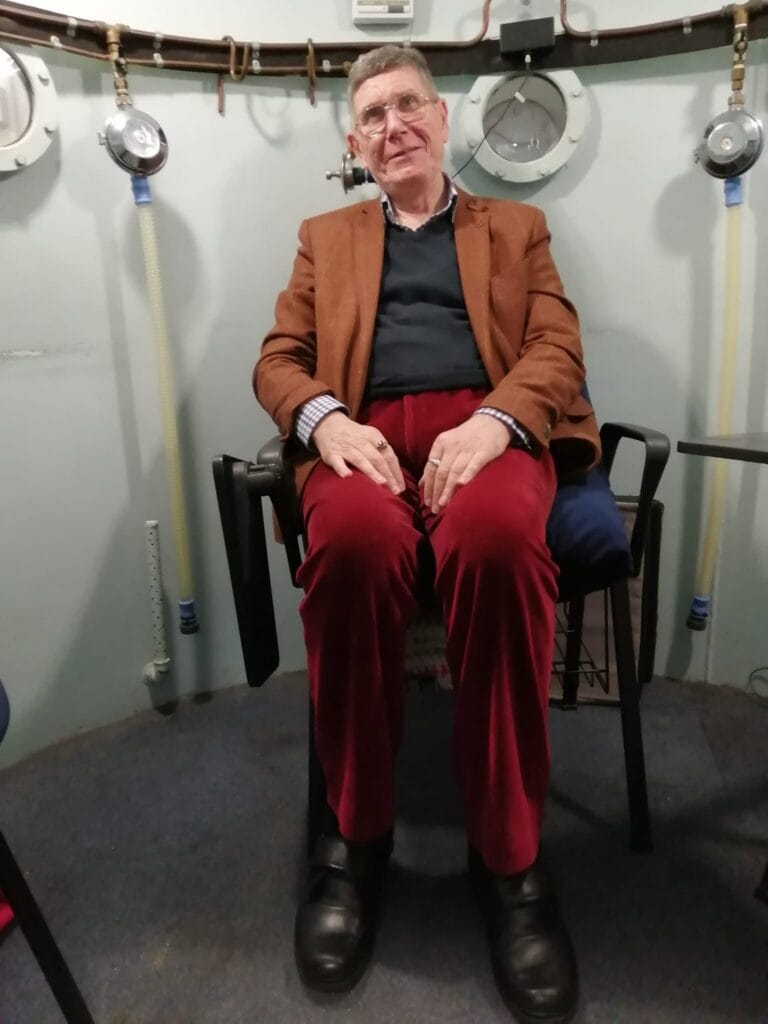
What has the disease done in those decades? His legs began to weaken only at about 76. Today, at 86, they bear weight but no longer carry him; he uses a powerchair indoors and out, his wife is his primary carer, and he stopped driving only three years ago. Bowel and bladder function is affected. “Upper half functioning. Memory is excellent.”
His own assessment is cautious: “I have to assume oxygenation treatment has slowed down the progression of the symptoms which weaken the legs and walking ability.” He gives equal credit to his wife Linda: “She is a modern equivalent of Florence Nightingale.”
How does his case compare with the usual course of MS?
The best available benchmark is the Lyon natural-history cohort: 1,844 patients followed before disease-modifying drugs were widely used, which is the right comparison for someone who never took them. The study reports the median age at which patients reached three irreversible disability milestones on the Kurtzke scale: DSS 4 (limited walking without aid), DSS 6 (walking with a cane) and DSS 7 (wheelchair).
| Milestone | Typical course (Lyon cohort, median age) | Christopher |
|---|---|---|
| First symptoms | 29 | 1970s, in his 30s |
| Diagnosis | — | 1982, age 42 |
| DSS 4: walking limited, no aid | 44 | not until his mid-70s |
| DSS 6: needs a cane | 55 | around 76 |
| DSS 7: wheelchair | 63 | in his 80s |
| Disease-modifying drugs | — | none |
| Hyperbaric oxygen | — | weekly, 2.0 ATA, 1983 to about 2023 (2,000+ hours) |
Christopher reached each milestone roughly twenty years later than the median patient.
What this does and does not show
One person cannot prove a treatment works. Some people with MS have a naturally mild course: roughly one person in eight is still walking without major disability twenty years after their first symptoms. But even a mild course usually reaches a cane well before the age Christopher did; he walked unaided for some forty years after his first symptoms, longer than any of those studies follow, and that would stand out in any cohort.
What his story does show is the thing the trials never measured: weekly maintenance oxygen sustained for decades. A controlled trial of that is close to impossible, because nobody can keep a comparison group untreated for forty years. The centres have thousands of members like him, and their records are the only account anyone has of what it looks like.
Why the hypothesis refuses to die
Why would any of this work at all? MS is usually described as an immune disease, but a subset of MS lesions carry the molecular signature of oxygen starvation, myelin is mostly fat, and several of the enzymes that make those fats need oxygen as a raw material rather than as fuel. We go through that biology, and the animal studies in which breathing oxygen prevented demyelination, in a separate article: Myelin is made with oxygen.
Two things from it matter here. None of those mechanisms has been measured in MS patients before and after a course of hyperbaric oxygen therapy. And the same oxygen that builds lipids can oxidise them; whether a dose builds or burns depends on the tissue’s antioxidant defences, which are weakest where the disease is most active. Barnes found his damage signal in exactly those patients. This is the reason the dose question is not a footnote.
The dose the trials never tested
So: was the trials’ dose simply too high?
It is tempting to say yes, and a body of more recent work makes the temptation stronger. Paul Harch, who has treated chronic neurological injury with hyperbaric oxygen therapy for over thirty years, has argued in a series of publications that the injured brain responds within a narrow dose window and that pushing past it produces worse, not better, outcomes, a position we explored in an earlier Education article. His standard protocol sits at 1.5 ATA and he works below it when needed; the constant in his method is adjusting to each patient’s response. In 2024, Harch and Rhodes reviewed thirty years of their own records and documented 52 cases of chronic central nervous system oxygen toxicity below 2.0 ATA, 31 of them at 1.5 ATA and 9 below it, most reversible once the dose was reduced. Neubauer was saying something similar about MS in 1983. And Barnes’s retinal findings are, on their face, what a dose past the tissue’s tolerance would look like.
The trial record complicates the picture without overturning it. The two positive trials and the seven negative ones all sat inside the same high-dose band, so the Cochrane reviewers could find no dose effect; a review cannot find one below the lowest dose anyone tested. And a high dose does not fail everyone equally: the same 2.0 ATA that a mildly affected patient could use may have been, for a progressive patient, more than the tissue could handle.
The centres started at roughly half that dose — lower pressure, shorter sessions — and titrated by response. And the band below that — 1.1 to 1.5 ATA, the range where most home and mild hyperbaric chamber use now happens — has never been tested in MS in a controlled trial.
There is one body of experience below that line. In Moscow, the neurologist Natalya Kazantseva has treated around 260 MS patients since the 1990s at 1.05–1.1 ATA on ordinary air, having started at 1.2 ATA and moved lower because her results improved, and reports positive change in practically all of them. It is a single clinic’s experience, reported in patents and Russian-language sources, and nobody outside her clinic has examined the records. But it is the only MS data anyone has from below 1.5 ATA, and it is almost exactly the exposure the Newcastle trial used as its placebo. Nobody in Newcastle intended a treatment or measured whether those ten minutes did anything, and the placebo group deteriorated much as the oxygen group did, so nothing can be claimed for it. But by the standards of the one clinic that works at that pressure, it was a short session, not nothing.
The centres today
The centres never went away. Now organised as the Neuro Therapy Network, more than forty of them across the UK, Jersey and Gibraltar still run hyperbaric chamber sessions for MS and other neurological conditions, on essentially the protocol Perrins described. The cost is a few pounds a session. Some members have attended for over thirty years; Christopher, whose story is above, attended for some forty.
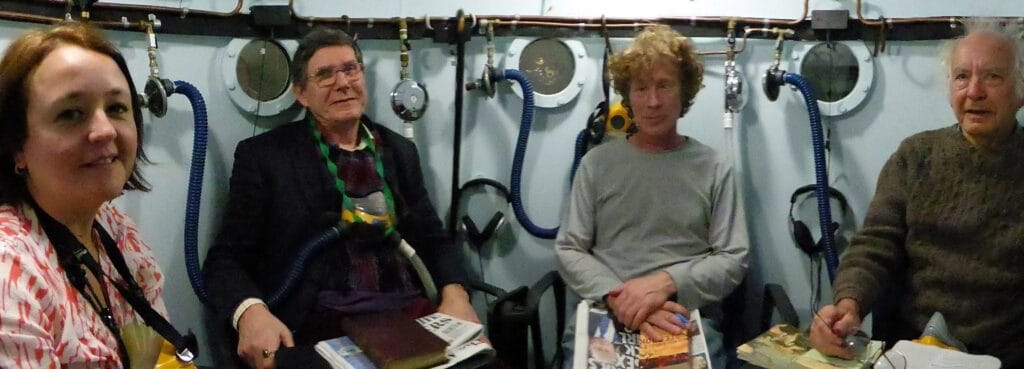
What members describe on the centres’ own pages, and these are descriptions rather than study results, is a consistent handful: fatigue, balance, bladder urgency, sensation, sleep. The centres are equally consistent about the limits: this is not a cure, the disease does not stop, and the best time to start is as early as possible after diagnosis, which is almost word for word what Fischer observed in 1983 and Perrins in 2005.
Where this leaves us
Two things the evidence supports reasonably well. Twenty sessions of pure oxygen at 2.0 ATA, given once, do not change the course of MS in most people — that is what the trials tested, and that is what they found, with the exceptions of Fischer and Oriani unexplained. And oxygen at that dose is not free: it stresses tissue in ways the Newcastle trial could measure, and more so in people whose disease is active.
Two things the evidence cannot settle. Whether a longer, gentler, individually titrated course — the thing the centres have done for forty years and no trial has ever tested — does something the twenty-session trials could not see. And whether mild hyperbaric oxygen therapy — the range the centres never went below and the trials never reached — could help people with MS in ways the high-dose trials were never designed to see.
And one thing that is simply true. Somewhere between millions of hours in the centres and nine trials there is a study nobody has run: starting at a mild dose, adjusting it by response, continuing for years, and measuring not just disability scores but the biology — myelin lipids, oxidative markers, remyelination — that would tell us whether the hypothesis Philip James floated in 1982 was wrong, or just tested at the wrong dose for the wrong length of time. Bennett and Heard doubted anyone would fund it. Until someone does, the patients in the centres and the neurologists who reviewed the trials will go on describing the same therapy and reaching different conclusions — because they have been looking at different things.
Educational disclaimer
This research and the centres’ work were conducted in clinical or supervised settings. Results from clinical research cannot be directly applied to other settings or devices — always consult a healthcare professional.
This content synthesizes findings from published medical research for educational purposes only.
The hyperbaric chambers sold on this website are non-medical wellness devices and are not intended to diagnose, treat, cure, or prevent any disease.
The studies discussed here were conducted in clinical medical settings using medical-grade interventions. The inclusion of research summaries does not imply that similar outcomes can be achieved using non-medical wellness devices.
Sources
Clinical trials and reviews
James PB. “Evidence for subacute fat embolism as the cause of multiple sclerosis.” The Lancet, 1982. DOI
Fischer BH, Marks M, Reich T. “Hyperbaric-oxygen treatment of multiple sclerosis: a randomized, placebo-controlled, double-blind study.” New England Journal of Medicine, 1983. PubMed
Barnes MP, Bates D, Cartlidge NEF, French JM, Shaw DA. “Hyperbaric oxygen and multiple sclerosis: short-term results of a placebo-controlled, double-blind trial.” The Lancet, 1985. DOI
Barnes MP, Bates D, Cartlidge NEF, French JM, Shaw DA. “Hyperbaric oxygen and multiple sclerosis: final results of a placebo-controlled, double-blind trial.” Journal of Neurology, Neurosurgery and Psychiatry, 1987. PMC
Neiman J, Nilsson BY, Barr PO, Perrins DJD. “Hyperbaric oxygen in chronic progressive multiple sclerosis: visual evoked potentials and clinical effects.” Journal of Neurology, Neurosurgery and Psychiatry, 1985. PMC
Wiles CM, Clarke CRA, Irwin HP, Edgar EF, Swan AV. “Hyperbaric oxygen in multiple sclerosis: a double blind trial.” British Medical Journal, 1986. DOI
Harpur GD, et al. “Hyperbaric oxygen therapy in chronic stable multiple sclerosis: double-blind study.” Neurology, 1986. DOI
Bennett M, Heard R. “Hyperbaric oxygen therapy for multiple sclerosis.” Cochrane Database of Systematic Reviews, 2004 (updated 2011). PMC
Bennett M, Heard R. “Hyperbaric oxygen therapy for multiple sclerosis.” CNS Neuroscience & Therapeutics, 2010. DOI
Perrins DJD, James PB. “Long-term hyperbaric oxygenation retards progression in multiple sclerosis patients.” International Journal of Neuroprotection and Neuroregeneration, 2005. PDF
Bates D. “Hyperbaric oxygen in multiple sclerosis: discussion paper.” Journal of the Royal Society of Medicine, 1986. PMC
Cook I. “Hyperbaric oxygen therapy for MS.” MS-UK, 2025. Link
Natural history of MS
Confavreux C, Vukusic S. “Age at disability milestones in multiple sclerosis.” Brain, 2006. DOI
Hirst C, et al. “Change in disability in patients with multiple sclerosis: a 20-year prospective population-based analysis.” Journal of Neurology, Neurosurgery and Psychiatry, 2008. Link
Matas E, et al. “Benign multiple sclerosis: a 30-year follow-up.” Journal of Neurology, 2025. Link
Dose and toxicity
Harch PG. “Hyperbaric oxygen in chronic traumatic brain injury: oxygen, pressure, and gene therapy.” Medical Gas Research, 2015. PMC
Harch PG, Rhodes S. “Acute and chronic central nervous system oxidative stress/toxicity during hyperbaric oxygen treatment of subacute and chronic neurological conditions.” Frontiers in Neurology, 2024. PMC